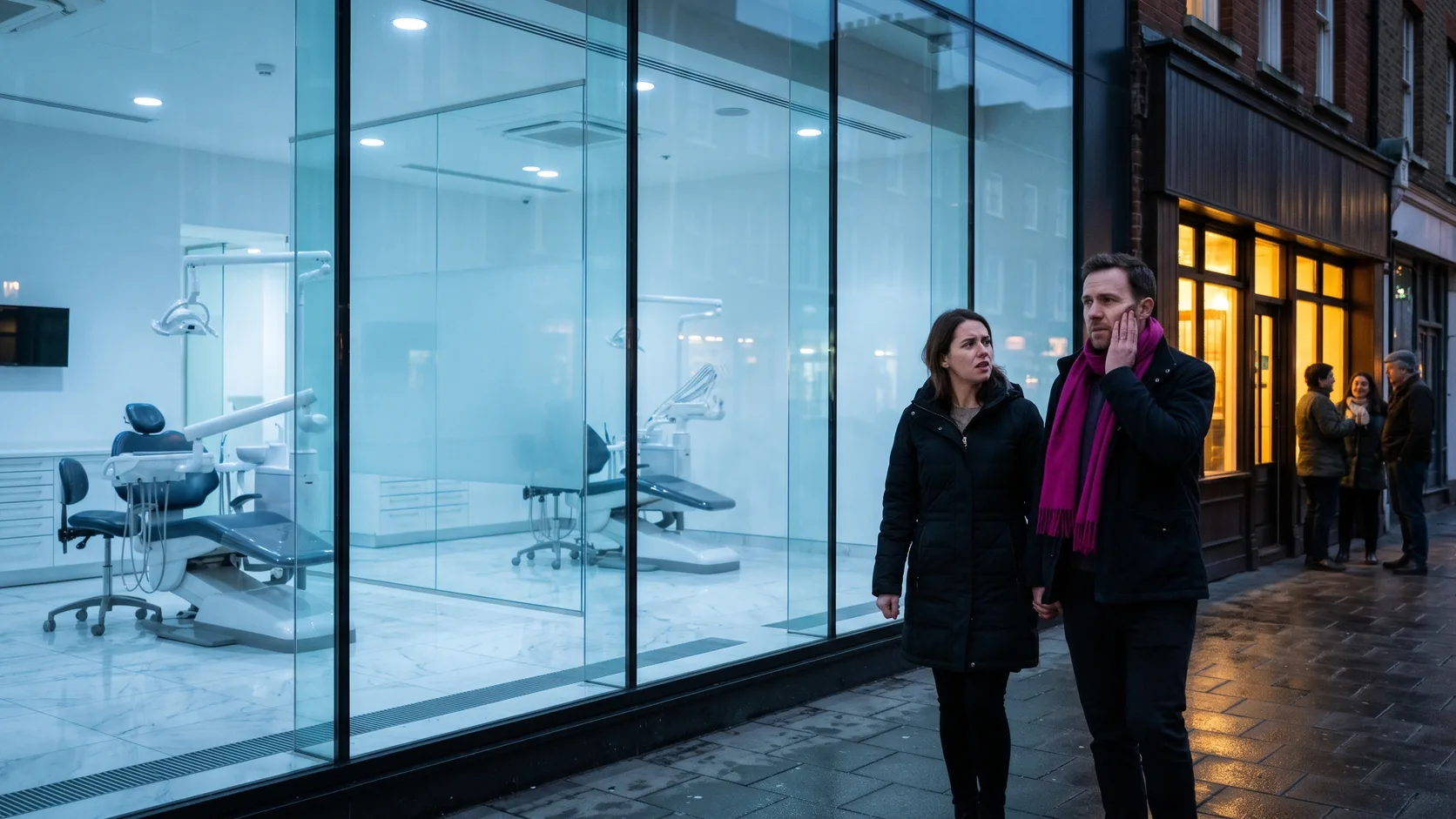

You paid for a new dental website, the designer showed you mockups full of dazzling white smiles, the site went live, and the phone at reception rings exactly as often as it did before. Meanwhile your Google Business Profile shows hundreds of views a month, some people tap “Directions” and “Call”, and only a handful click through to the website. Sound familiar? It doesn’t necessarily mean the site is bad or that your SEO specialist did nothing.
What changed is the patient’s path. Today people find a dental clinic on Google Maps, through a colleague’s recommendation, on Instagram, through ads, or simply because the clinic is on the ground floor of the building next door. They open the website later, when they’ve almost decided, and they come to it with one question: “Is this place all right or not?”
So a dental website has a different job than it did ten years ago. It doesn’t so much bring in visitors as confirm trust. And that is exactly the job many beautiful websites fail at. Below we’ll look at why, and to keep it concrete, we’ll carry one made up example through the whole text: a family clinic with two chairs in a residential area of a regional city, with a new website and an almost empty listing on Google Maps.
1. Dentistry lives within a radius of a few blocks
People are happy to look for an accountant in another city, but almost never for a dentist. Treatment, cleaning, a child’s checkup all mean regular visits, so what decides it is how easy the place is to get to.
People usually look at clinics:
- near home or work;
- at their own metro station or bus stop;
- where there’s somewhere to park;
- on the way to their child’s school or nursery.
Google says this outright: in its help article on local ranking, it names distance from the person searching as one of the three main factors (Google Business Profile Help). So the clinic in our example isn’t competing with every dental practice in the city, only with the few nearest ones. You can’t beat geography with a website, but the battle takes place on a small patch of ground, where simple things decide a lot.
Before you put money into a redesign, stand outside the clinic, open Google Maps on your phone and type “dentist”. Who’s nearby, how many reviews they have, what photos: that is your real competition.
2. How people choose a dentist today
The old path was search, then the clinic’s website, then a call. Now it’s most often like this: map, rating, number of reviews, photos, a few recent reviews, a call or a booking. The website fits into this chain somewhere between the photos and the call, and sometimes only after the call, when the person wants to be sure they didn’t get it wrong.
| What the person sees | Where they see it first | What puts them off |
|---|---|---|
| Rating and number of reviews | Google Maps listing | 4.9 from six reviews over five years |
| Photos of the clinic | Google Maps listing | Only a logo and a stock smile |
| Opening hours | Listing, then website | Different hours in the listing and on the site |
| Phone, call button | Listing, then website | A number nobody answers |
| Who does the treatment | Website | No names, no faces |
| Can I get in at a convenient time | Website, call | A form followed by silence |
Most decisions are made before the website, and the photos and hours in the Business Profile often go years without an update. Our example clinic is exactly like that: the website is new, but the listing shows a photo of the front taken three years ago, when a different sign still hung there.
3. Why good design no longer guarantees anything
Many dental websites today aren’t bad. On the contrary, they look expensive: video on the first screen, smooth animations, sliders, translucent blocks, photos of models with perfect teeth. The problem is that “expensive” and “trustworthy” are different things in a patient’s eyes.
Open the websites of three or four clinics in your area one after another: most likely they’ll blur into a single picture of turquoise and white, stock smiles and “an individual approach”. People don’t remember how they differed and go back to the map, where at least they can see reviews.
And on a phone with mobile internet, a heavy “premium” template is slow on top of that: while the video loads, the person has already called the clinic next door.
Signs that the design is working for itself, not for the patient:
- the phone number and address aren’t visible without scrolling;
- the first screen has a slogan instead of an answer to “what do they treat here and where is it”;
- photos of people who don’t work at the clinic;
- animation appears before the text.
4. What really affects trust
A patient doesn’t judge a website like a designer. They’re looking for answers to a few anxious questions, often without even putting them into words:
- is this a real clinic or a shop window?
- who will treat me?
- is it clean and safe here?
- will they draw up a treatment plan worth half my monthly salary instead of one filling?
- is it scary to come here?
The website answers each of these questions either with a fact or with a vague phrase. Compare:
| The patient’s question | An answer that doesn’t work | An answer that works |
|---|---|---|
| Is this a real clinic? | “A modern clinic of European standard” | Address, a photo of the entrance from the street, how to find the door in the courtyard |
| Who does the treatment? | A stock photo of someone in a white coat | Names, photos and specialisms of the real dentists |
| Is it safe here? | “The highest sterilisation standards” | A photo of the sterilisation room, an explanation of how instruments are processed |
| Will they rip me off? | “Affordable prices” | What the first examination includes and how the treatment plan is agreed |
| Is all this legal? | Nothing | Licence or registration details for the medical practice |
The last row gets underestimated. In many countries a dental practice needs a licence or registration, and the website is where a patient expects to see it. In Germany, for example, the Digitale-Dienste-Gesetz requires providers in regulated professions to state in their legal notice the professional chamber they belong to, their statutory professional title and the country that awarded it, and where the professional rules can be found (§ 5 DDG, German Digital Services Act); in Ukraine, medical practice is on the list of licensed activities (Law on Licensing, Article 7(1)(15)). The name of the legal entity and the licence or registration details in the website footer cost nothing, yet to someone going to an unfamiliar clinic for the first time they say more than any animation.
Before and after photos and reviews: where trust runs into the law
In another niche, before and after photos and customer reviews would be a marketer’s first piece of advice. In medicine it’s more complicated.
In most countries, advertising medical services is strictly regulated, and the rules differ from country to country. Take Germany as an example. Its Heilmittelwerbegesetz (Therapeutic Products Advertising Act, HWG) also covers advertising for treatments and procedures when the claim relates to recognising, curing or relieving diseases (§ 1). Section 11 of the act (HWG, § 11) restricts what can be shown to the general public, including:
- images of changes to the body caused by disease or injury, if used in an abusive, repellent or misleading way;
- statements by third parties, in particular letters of thanks, recognition or recommendation, if used in an abusive, repellent or misleading way;
- for cosmetic surgery without medical necessity, any comparison of the body before and after the procedure;
- and under § 3, advertising is misleading if it falsely creates the impression that success can be expected with certainty.
Dentists in Germany are also bound by the professional rules of their dental chamber. Ukraine’s Law on Advertising (Article 21) is stricter and bans, among other things, before and after images of body changes caused by disease, references to specific successful cases, thank you letters and patient stories, and claims that a treatment effect is guaranteed.
What this means for a dental website and dental advertising on social media: a “before/after” banner captioned “implants in a single day”, a grateful patient’s quote in an ad post, or a dentist in a video promoting a specific method are all high risk territory. Where exactly information about the clinic ends and advertising a treatment method begins isn’t spelled out in the law, so the before and after format, a collection of reviews on the site and dentists appearing in promos should be cleared with a lawyer who knows medical advertising in your country. We’re not lawyers and won’t give you a legal opinion.
There’s a second layer too. A photo of a patient’s mouth, their treatment history and even the mere fact that someone was treated at your clinic all concern health. In the EU, the GDPR treats data concerning health as a special category: Article 9(1) prohibits processing it except in the cases listed in Article 9(2), and the first of them is the person’s explicit consent (GDPR, Article 9). So photos aren’t published without the patient’s written consent, not even in your own portfolio.
Now for Google reviews, because you can and should work with them. Google Maps policy lets you ask patients to leave a review of a real experience, but prohibits:
- offering a discount, a gift or any other incentive for a review;
- asking for reviews selectively, only from happy patients, or discouraging negative ones;
- pressuring people to write a review right there in the clinic;
- asking them to include specific content, such as the name of a particular dentist;
- setting staff targets for the number of reviews.
All of this is listed explicitly in the Google Maps content policy (Maps User Contributed Content Policy). So when the receptionist says “please mention that Dr Olena treated you”, it breaks the rules, however innocent it sounds.
A workable setup for our example clinic: after the treatment is finished, the patient gets a message with a short link or QR code for leaving a review (Google itself offers this tool in its help article on reviews), with no strings attached. One person writes the replies to reviews. And this matters: in a reply, don’t confirm a diagnosis, a treatment or even the fact of a visit. Google advises never to disclose the reviewer’s private information, and in medicine this is also a question of health data. A sample reply to a negative review:
“Thank you for writing. We want to get to the bottom of this, but we can’t discuss the details in public. Please call our reception on the number in our profile or email the clinic, and we’ll get back to you today.”
5. For dental clinics, Google Maps often matters more than SEO
In a local niche, a large share of first enquiries comes from the map listing, not from organic results. For a search like “dentist near me”, Google shows a map with ratings and call buttons, and there’s no need to click anywhere.
Google says local results are based mainly on relevance, distance and prominence. Prominence is partly determined by the number of links to the business and the number of reviews, and more reviews and positive ratings can help local ranking. The same page says you can’t ask for or pay for a better local ranking (Google Business Profile Help).
A Business Profile checklist to start your dental marketing with:
- The profile is verified. Without verification you don’t fully control the listing and can’t see its statistics.
- The category is precise. The primary category is about dentistry. Google advises choosing as few categories as possible to describe your core business, so don’t add everything you can think of.
- The name matches the sign. The name should be the real one, as on your sign and documents, and the Business Profile guidelines forbid adding marketing slogans, service names or location details to it (guidelines for representing your business).
- Hours and phone match the website. Including public holidays.
- Real photos. Google recommends at least three exterior and three interior photos, and the pictures should be sharp, well lit and free of heavy editing, filters or AI: the image should show reality (tips for photos).
- Separate profiles for dentists, where it makes sense. Google counts dentists among “individual practitioners”, who under certain conditions can have their own profile. Before creating one, read the conditions in the same guidelines so you don’t end up with duplicates.
Check how people behave. The profile’s Performance section shows views, search queries, calls, direction requests and website clicks (Business Profile performance). If our example clinic has hundreds of views, dozens of direction requests and a handful of website clicks, that’s a normal picture for a local business, not a website failure. The failure is when there are plenty of website clicks but no calls after them.
6. Why dental SEO has become harder
Articles like “what to do if you have toothache” used to bring clinics traffic. Today Google often answers such searches right in the results, including with AI Overviews, and the person doesn’t open a single website.
On top of that, dentistry belongs to the topics Google calls YMYL (“Your Money or Your Life”): they can significantly affect a person’s health or wellbeing. For these topics, content should be highly accurate and reflect well established expert consensus (Google Search Central). A blog of rewritten articles from elsewhere loses here both to medical portals and to the results page itself.
What’s left for a dentist’s website:
- commercial local searches: the person is looking for a specific service in their city or neighbourhood and needs a clinic, not an article;
- branded searches: the person has already heard the name from friends and is checking;
- specific questions from the clinic’s patients: how to prepare for a visit, what to do after an extraction as recommended by your own dentist, how the guarantee on the work operates.
So dental marketing today is first of all the Business Profile, reviews and clear service pages, with a blog only where the clinic really has something to say. If you want to work out what you can do yourself and where you need systematic work, see how we approach SEO.
7. The biggest mistake: a website about everything and nothing
A typical situation: a single “Services” page where general dentistry, oral surgery, orthodontics, implants and children’s appointments are mixed into one paragraph. Google can’t tell which page answers a search about braces, and a person who came with exactly that question doesn’t see an answer and leaves.
What bad and good look like, using our example clinic:
- Bad. “We provide a full range of dental services for the whole family.” Below it, a list of fifteen names with no links.
- Good. A separate page for each area people actually come to you with, and on each one, in plain language: what problem brings people here, how the first visit goes, which dentist handles it, how to book.
What matters isn’t the number of pages, but that each one answers one patient question and is easy to reach from the menu. We covered how to build that kind of structure in detail in our article on website navigation and structure. And the basics every business website needs, from contacts to analytics, are collected in the article “Business website must-haves”, so we won’t repeat them here.
8. A dental website as a checkpoint, not the main channel
Wherever the person came from, at that moment the website confirms that the clinic can be trusted: it shows who does the treatment and doesn’t get in the way of booking.
So don’t measure the number of visitors; measure how many of them then called or booked. Two things are enough for that:
- add a UTM tag to the website link in your Business Profile, so that in Google Analytics you can tell apart the people who came from the map;
- ask the receptionist to note how each new patient heard about you: from friends, from the map, from an ad, from the website.
It sounds old fashioned, but for a clinic with two chairs, there’s no more accurate analytics.
9. What really works today
Real photos
A photo of the clinic taken on an ordinary working day, when you could walk in, works better than any glossy template. People need to see:
- the entrance from the street, so they can find the door;
- reception and the waiting area;
- the treatment room and the chair;
- the dentists, with their names.
An imperfect, real photo persuades better than a stock shot people recognise instantly. And AI generated “patients” destroy trust for good: if the face is fake, why believe the rest?
Simplicity
A patient wants to find six things and leave: the service, the price or at least how the cost is worked out, the phone number, the address, the dentist, a way to book. If any of these is hidden in a third level menu or in a nine page PDF price list, the website is working against the clinic.
A simple test: hand a phone with the website open to someone who has never seen it and ask them to find the address and phone number within a minute. Time it and keep quiet.
A decent mobile version
Google indexes and ranks websites based on their mobile version (Google Search Central), and patients mostly look for a dentist on their phone. Check the share for your clinic in your analytics, but for a local niche it’s usually large.
What breaks the mobile version:
- a promo popup that covers half the screen and has a close button the size of a poppy seed;
- small text and buttons that are hard to hit with a finger;
- a phone number as an image you can’t tap to call;
- a page that jumps around while banners load.
Speed
Heavy videos, animations, unoptimised photos and a dozen scripts make the site slow exactly where it gets opened: on mobile internet. Google considers it a good experience when the largest element on the page (LCP) appears within 2.5 seconds, the response to an interaction (INP) doesn’t exceed 200 milliseconds, and layout shift (CLS) is no more than 0.1 (web.dev). We explained how to check these metrics yourself, without a developer, in our article on Core Web Vitals.
10. Why a simple template sometimes works better than expensive design
Studios won’t like hearing this, but a simple website on an ordinary template often beats the “wow project”. It’s faster, it’s harder to get lost in, and it doesn’t try to make the clinic look bigger than it is.
In medicine, people aren’t looking for an experience. They’re looking for a sense of safety, clarity and predictability. That’s why among dental practices you’ll find clinics with very modest websites and a steady flow of patients: they simply have everything in order with what the patient sees before and after the website, meaning the map, reviews and reception.
Design isn’t the enemy here, it just has its proper place in the queue: speed, clarity and real photos first, style after.
11. What changed when AI came to search
More and more often, Google answers people right in the results, including through AI Overviews and AI Mode. The classic chain of “articles, traffic, website, patient” works less well for local services. But that doesn’t mean the website has become unnecessary.
Google itself says there are no additional requirements or special optimisation for appearing in AI Overviews; the usual SEO fundamentals apply: important content in text form, structured data that matches the visible text, an up to date Business Profile. No special “AI files” or extra markup are needed (AI features and your website).
For a dental website, this leads to three simple actions:
- the address, opening hours, services and dentists’ names are written as text, not only in images or a banner;
- the details on the website, in the Business Profile and on social media are the same;
- there are no promises that search or AI could quote against you, like “painless and forever”.
12. What a dental website should be: a half hour check
Go through this list on your own phone, using mobile internet:
- [ ] the first screen says it’s a dental clinic, in which area, and gives a phone number you can tap;
- [ ] the address and hours match your Google Business Profile;
- [ ] the photos are real: entrance, treatment room, dentists;
- [ ] every dentist has a name and a specialism;
- [ ] every area of service has its own clear page;
- [ ] the legal entity’s details and the licence or registration details for the medical practice are there;
- [ ] there are no before and after photos, patient quotes or promises of guaranteed results that a lawyer hasn’t cleared;
- [ ] popups don’t cover the content;
- [ ] the page opens fast and doesn’t jump while loading.
If you’d like someone from outside to look at it, there’s our free website check: SEO, AI search and trust.
And if the check makes it clear that the site is easier to rebuild than to fix, first figure out how to choose a website developer: ask to see live sites on your own phone and ask who will be responsible for speed and for patient data in forms.
13. Conclusion
A dental website stopped being the main source of patients a long time ago. First contact happens on the map, through recommendations and in ads, and the website has become the place where people make the final call on whether to trust the clinic.
So the problem with most of these websites isn’t that they’re not beautiful enough. They don’t answer the patient’s simple questions, they hide real people behind stock photos, they open slowly on a phone and they live separately from the Business Profile. Start with the map listing, reviews and photos, not with a new redesign.
If you’d like us to look at your clinic’s website and Business Profile together and tell you what can be fixed in a week and what needs website development, write to us.
14. FAQ
15. Sources
- Google Business Profile Help, Tips to improve your local ranking on Google
- Google Business Profile Help, Tips to get more reviews
- Google Business Profile Help, Guidelines for representing your business on Google
- Google Business Profile Help, Tips for business-specific photos
- Google Business Profile Help, Understand your Business Profile performance & insights
- Google Maps, User Contributed Content Policy, Fake engagement and Rating manipulation
- Google Search Central, Creating helpful, reliable, people-first content (YMYL)
- Google Search Central, AI features and your website
- Google Search Central, Mobile-first indexing best practices
- web.dev, Web Vitals
- Google Ads Policies, Healthcare and medicines
- Ukraine, Law on Advertising, Articles 1 and 21
- Ukraine, Law on Licensing of Types of Economic Activity, Article 7
- Regulation (EU) 2016/679 (GDPR), Article 9
- Germany, Heilmittelwerbegesetz (HWG), §§ 1, 3, 11
- Germany, Digitale-Dienste-Gesetz (DDG), § 5